- 100 Posts
- 42 Comments
relianceschool@lemmy.worldOPto
Technology@lemmy.world•Cornell Study Maps the Environmental Cost of AIEnglish
11·6 days agoYeah, I’m not a big fan of the “don’t build data centers here, build them there” conclusion of the report. I see no reason why we should be allowing these monstrosities to be built in the first place, they’re a total waste of essential resources.
relianceschool@lemmy.worldto
No Stupid Questions@lemmy.world•Is there any way the average American can insulate themselves from the AI bubble bursting?English
1·26 days agoI don’t see the AI bubble burst affecting people to the same degree; I think it’ll wipe out a lot of investment portfolios, but non tech-sector jobs should be safe. I think it’s useful to have some essentials on hand, but I wouldn’t go on a buying spree if that means draining my savings; I’d rather have the flexibility of money. If it comes down to survival and you don’t have savings, you could preemptively apply for lines of credit, use those to cover living expenses, and declare bankruptcy once they’re wrung out. Not financial advice, but it’s an effective stopgap.
relianceschool@lemmy.worldto
No Stupid Questions@lemmy.world•Is there any way the average American can insulate themselves from the AI bubble bursting?English
2·26 days agoYou’re catching downvotes, but according to Google Trends, searches for “gold price” and “ai bubble” are positively correlated, and there’s plenty of historic precedent for people flocking to “safe haven” assets when the markets nosedive. Gold went up by 30% from Jan-Sep 2020 (COVID), and nearly doubled in value between 2007 and 2009 (housing crisis), although it did take a dip before rebounding during the dotcom bubble (2000-2003).
That said, I would recommend keeping a significant portion of your money in an HYSA as precious metals are subject to large fluctuations in price and markets don’t always behave rationally.
relianceschool@lemmy.worldto
No Stupid Questions@lemmy.world•Is there any way the average American can insulate themselves from the AI bubble bursting?English
4·26 days agoThis is all great stuff to have on hand, but not relevant for OP’s question. They’re wondering how to prepare for the equivalent of the dotcom burst or the 2008 recession, not a grid-down scenario.
relianceschool@lemmy.worldto
World News@lemmy.world•As Gold Hits New Record, Some See Warning Signs of Civilizational CollapseEnglish
81·29 days agoIf you’d bought silver (or silver ETFs) a few months ago you would have made a whole bunch of money, and society hasn’t ended yet.
Poorer nation’s peak population estimates are declining every year, as life gets better and child mortality falls population growth lowers everywhere
Yes, that’s a good thing.
(another racist shit that’s spreading that poor nations are reproducing too much, btw).
Race doesn’t enter into it. If we accept that we crossed into overshoot over 50 years ago, then any birth rate above replacement is ultimately unsustainable.
Energy consumption is more or less useless measure with the rapid rise of renewables, although there are also efforts there to lower that everywhere.
Energy consumption is the measure. It’s a direct reflection of the degree to which our lifestyles impact our environment. People seem to have this idea that the only real issue with industrial civilization is that it runs primarily on a fuel that destabilizes our atmosphere, and that if we could simply transition away from this fuel (to solar/wind/nuclear/fusion) we’d be on our way to utopia.
But let’s consider what we direct all that energy towards: first, we use it to harvest massive amounts of natural resources, degrading and destroying the environment in the process. (Mining, logging, farming, fishing, etc.) We then transform those natural resources into towns and cities, which pave over and fragment the natural environment in which they’re built. We transform them into consumer goods (cars, electronics, plastics, clothing, etc.), the vast majority of which end up as waste in less than a decade. We transform them into all manner of industrial chemicals, many of which end up becoming individual ecological disasters of their own.
Transitioning to a “clean” form of energy does nothing to address what we do with it. Living sustainably requires drastically downscaling our total ecological footprint.
relianceschool@lemmy.worldto
World News@lemmy.world•Ireland plans to make a $1,500 a month basic income for artists permanentEnglish
3·29 days agoBut the famous director gets hundreds of thousands every year to make shitty movies nobody sees, because that one time 20 years ago he did something good.
To be fair, this is also how it works in Hollywood.
We are not over capacity at all
We’re in a state of ecological overshoot, defined as a population consuming more resources than its environment can replenish. At its simplest, overshoot is a function of individual consumption x total population.
The Global Footprint Network calculates that we crossed this line in 1971, when both our global population (3.8B) and individual energy consumption (15.8kWh) were far lower than they are today (8.2B and 21.7kWh, respectively). Consider also that population is both a cause and effect of energy consumption.
the wealthiest 10% causes over 50% of the pollution.
You’re referring to CO2 emissions here (and it’s actually closer to 60%), but there are many other symptoms of overshoot. Habitat loss, species extinctions, overharvesting of resources, and other forms of pollution (industrial, particulate, trash) are huge problems in less wealthy nations. In South America, for example, we’ve seen a 95% loss of wildlife species over the past 50 years. The planetary boundaries framework is helpful for looking at overshoot more holistically, instead of focusing solely on emissions (although that’s important too).
In wealthy nations, populations are declining but consumption is unsustainable. In poorer nations, individual consumption is low but population growth is unsustainable. Only by reducing both do we have a hope of living equitably on this planet.
relianceschool@lemmy.worldto
Technology@lemmy.zip•‘Death to Spotify’: the DIY movement to get artists and fans to quit the music appEnglish
2·1 month agoYup. I’m old-school, I like owning my music. Streaming platforms are notorious for dropping artists due to licensing/royalty disputes, and artists also pull their music from platforms for various reasons as well. I love my Sony NW-50, it’s got room for thousands of tracks in lossless (FLAC) format, and you don’t need an internet connection to listen (great for road trips).
It’s a different mindset; you can still have a huge library, but you get to know your music, since you’re not constantly getting random recommendations. I have a few albums that I’ve absolutely worn out, and it feels a little nostalgic in that way (anyone who grew up with CDs has that one album that you listened to 500 times in your car because you were too lazy to take it out).
relianceschool@lemmy.worldto
Technology@lemmy.world•Everyday AI looks more like the '08 housing bubbleEnglish
1·1 month agoIf people think it’s a bubble, then it’s a bubble! (Self-fulfilling prophecy.) Google Trends is a decent gauge of public sentiment. That said, the fundamentals are pretty flawed too.
relianceschool@lemmy.worldto
Technology@lemmy.world•Everyday AI looks more like the '08 housing bubbleEnglish
4·1 month agoTrue, but consider that a huge amount of retail investors’ portfolios are tied to the S&P 500/NASDAQ. Think retirement savings, IRAs, 401(k)s, pensions, etc. Then consider that the entire market is effectively propped up by AI right now (see: The entire stock market is being carried by these four AI stocks). If the market gets a 60% correction, it’s going to be the middle class losing their shirts all over again.
relianceschool@lemmy.worldOPto
Mycology@mander.xyz•In mind-bending twist, ‘magic’ mushrooms evolved twice independentlyEnglish
6·1 month agoSorry about that, I pasted the thumbnail URL instead of the article URL. Post is updated.
relianceschool@lemmy.worldOPto
Fuck AI@lemmy.world•The AI bubble is the only thing keeping the US economy together, Deutsche Bank warnsEnglish
1·2 months agoFrom the perspective of companies investing in AI, the idea is to spend less but generate the same (or higher) profit. For example, let’s say you sell software, but a big part of your cost is coding & developing it. The pitch is that you can code it with AI agents at a fraction of the cost, and increase your profits accordingly.
So companies don’t see this as an economic net-negative. But to your point, I’m not sure if those same companies are considering that if no one’s paying people to create products, there will be no one with money to buy them.
relianceschool@lemmy.worldOPto
Biodiversity@mander.xyz•‘Landmines have become protectors’: how wildlife is thriving in a demilitarized zoneEnglish
1·3 months agoAgreed, that’s the only reason I’d want a huge amount of money. Conservation easements and land trusts all day.
relianceschool@lemmy.worldOPto
Biodiversity@mander.xyz•Why are wind turbines killing millions of bats?English
2·3 months agoA lot of the time they simply can’t adapt, not quickly enough at least.
Yes, that’s the key point. Individual species take a long time to adapt through evolution, and ecosystems can adapt at the cost of losing some species, but nothing can adapt at the speed and scale with which humanity is reshaping the Earth. A huge portion of the planet is no longer suitable for anything other than generalists, scavengers, and invasives.
relianceschool@lemmy.worldOPto
Fuck AI@lemmy.world•How To Argue With An AI BoosterEnglish
1·3 months agoI see this less as a kit for arguing with folks in real life (or worse, on the internet), and more of an exploration/dissection of common arguments put forth by the pro-AI crowd. So the next time you see those points pop up in an article or editorial, you can more easily evaluate whether or not they hold water.
Seems like you’d just lift up the mattress like they did for this picture.
relianceschool@lemmy.worldto
[Dormant] moved to !historyphotos@piefed.social@lemmy.world•Diver, having passed through the antiseptic germicide trap, enters the germ-free animal colony. University of Notre Dame, Indiana, 1950English
231·3 months agoWhat exactly did they mean by “germ-free”? Over half the cells in our bodies are non-human microbes.


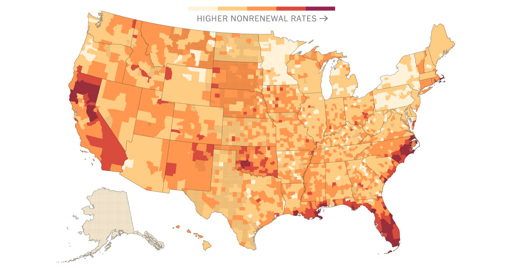
I’m generally on board with that, and several states (including mine) are creating last-resort plans for homeowners who are unable to get private coverage. That said, this has to be accompanied with some kind of carrot-and-stick initiatives to move people out of high-risk areas. I don’t want my taxpayer dollars to subsidize insurance for beachfront properties or vacation homes in the mountains.