
You must log in or # to comment.
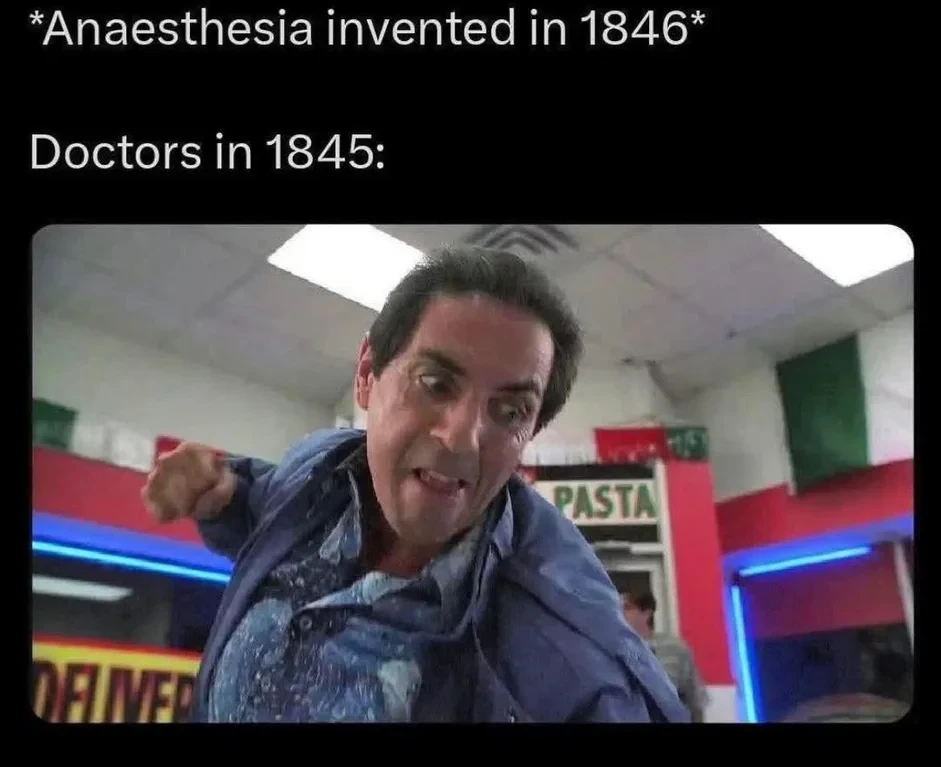
Explanation: Before anesthesia, it was actually considered that the best method of major surgery, like amputations, was whichever one got it done the fastest - as cutting into a conscious, writhing, screaming human being is difficult work.
Doctors putting out their patients with a single good punch is not, to my knowledge, on record, but is hilarious to think of.
Speed you say:
Amputated the leg in under 2 1⁄2 minutes (the patient died afterwards in the ward from hospital gangrene; they usually did in those pre-Listerian days). He amputated in addition the fingers of his young assistant (who died afterwards in the ward from hospital gangrene). He also slashed through the coat tails of a distinguished surgical spectator, who was so terrified that the knife had pierced his vitals he fainted from fright (and was later discovered to have died from shock).[29]
This episode has since been dubbed as the only known surgery in history with a 300 percent mortality rate. The situation that Gordon labels “Liston’s most famous case” has been described as apocryphal.[31][32] No primary sources confirm that this surgery ever took place.[33]
Thank you for including the disclaimer. I love that story, but I never repeat it for fear that someone will take it as more trivia than legend.
Before the use of anestetics speed was very much of the essence in surgery. One Robert Liston, a surgeon of significant repute, was said to be the fastest in the business. Apparently his could amputate a leg in 28 seconds. He was also the first to use anethesia in Europe, and was known for the quality of his patient care, so he wasn’t just showing off.
There was some (I don’t know how widespread) use of strong alcohols as sedatives. Get them drunk!
I used to joke about this weirdly enough. I called it ‘manual sedation’, lol.
Love me a “The Sopranos” moment. “Veal parmesean sandwich? F u c k y o u .”
The good ol’ Hollywood Hibernate. Side effects include ten seconds of wooziness but absolutely no physical harm.
Didn’t they already have opium at that point?
A painkiller/analgesic, but not a general anesthetic. General anesthesia puts you out, which is separate from painkilling or even sedation. A patient even with greatly reduced pain still often reacts to stimuli, and what you want most of all is for them to be still and unreactive.
Yeah, but using an actual painkiller is at least a lot better than getting punched out or drunk …